You Know the House Always Wins — So Why Can't You Stop Spinning?
Ask almost any regular pokies player in Australia whether the machine is designed to take more than it gives, and they'll nod without hesitation. Most can even throw around terms like RTP, house edge, or variance with reasonable confidence. The information is out there, it's widely discussed, and it's not exactly hidden by the platforms offering the games.
And yet — the reels keep spinning.
This isn't a story about ignorance. It's a story about something far more interesting: the gap between what we know and what we feel. And in Australia especially, that gap is wide enough to drive a road train through.
The Knowledge Gap That Isn't Really a Gap
There's a tempting assumption that if players just understood the maths better, they'd play less. But research into gambling behaviour consistently tells a different story. Cognitive awareness of odds doesn't reliably change behaviour — not in pokies, not in lotteries, not in sports betting.
Why? Because the part of your brain processing "this machine returns 95 cents in every dollar over millions of spins" is not the same part lighting up when three wilds line up and the screen erupts in colour and sound. One is abstract, statistical, and cold. The other is immediate, visceral, and deeply rewarding.
We're not wired to feel probability. We're wired to feel now.
This is sometimes called the experiential-analytical divide — the idea that humans operate on two tracks simultaneously. One track runs the numbers. The other track lives in the moment. And when those two tracks conflict, the emotional, experiential track tends to win the short-term battle, even when the analytical track knows better.
Pokies Are Uniquely Australian — And That Matters
To understand why Australians specifically seem so comfortable with this paradox, you have to appreciate just how deeply pokies are woven into the country's social fabric.
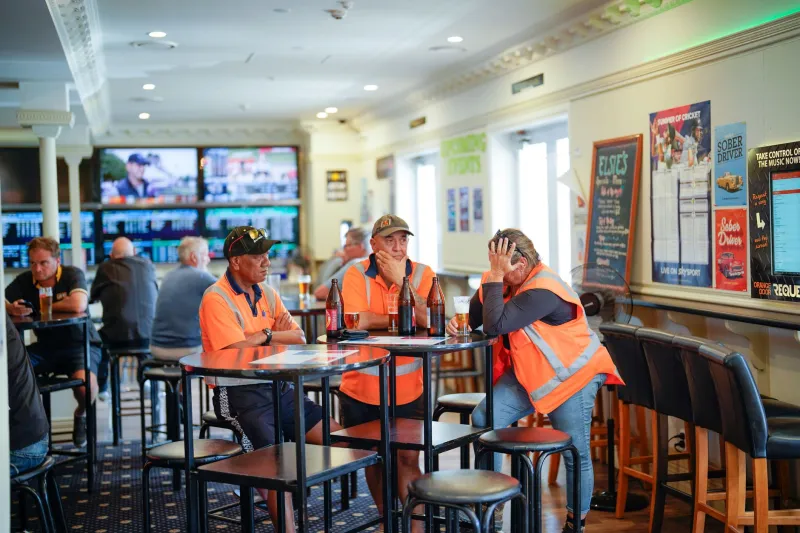
Australia has, per capita, one of the highest concentrations of poker machines in the world. For decades, the local pub or club pokies room wasn't a place you went to gamble — it was just where you went. Catch up with mates after work, have a parma, drop a few dollars in the machine. The gaming wasn't the event. It was the backdrop.
That cultural normalisation is powerful. When something is framed as leisure rather than risk-taking, the psychological calculation shifts entirely. You're not "gambling" — you're having a punt, same as everyone else at the table. The social context reframes the activity, and with it, the emotional weight of the odds.
Compare this to countries where gambling carries stronger social stigma or where it's far less visible in everyday settings. Players in those contexts approach the same games with more deliberate awareness of risk. In Australia, the familiarity breeds a kind of comfortable detachment from the mathematical reality.
Entertainment Value: The Argument That Actually Has Merit
Here's where it gets genuinely complicated: for a lot of players, the maths doesn't actually matter — and not in a delusional way.
If you budget $50 for a Friday night session, treat every spin as entertainment rather than investment, and walk away having had a couple of hours of genuine fun regardless of outcome, then the house edge is essentially the cost of admission. Same as a cinema ticket, a round of mini golf, or a few craft beers at a rooftop bar.
This is the entertainment framing, and it's a legitimate one when applied honestly. The problem isn't the framing itself — it's when it quietly shifts. When "entertainment budget" becomes a floor rather than a ceiling. When the fun stops and the chasing starts. When the reframing stops being a healthy mindset and starts being a rationalisation.
The line between those two things isn't always obvious in the moment, which is partly why so many players find themselves on the wrong side of it without quite knowing when they crossed it.
The Near-Miss: Engineering the Feeling of Almost
Modern pokies — whether you're playing in a club or on your phone — are extraordinarily sophisticated pieces of psychological engineering. And one of their most effective tools is the near-miss.
Two matching symbols land, the third stops one position short. The machine responds with a sound that feels almost like a win. Your brain, briefly, processes it similarly to one. Studies have shown that near-misses activate reward pathways in ways that losses alone don't — they create the sensation of being close, which encourages continued play far more effectively than a clean miss would.
This is important context for the paradox. Players aren't just overriding their rational understanding of odds — they're being nudged, repeatedly, by design features specifically engineered to keep them engaged. The knowledge that the house wins overall doesn't protect you from the feeling that this next spin might be the one.
Social Proof and the Stories We Tell Each Other
There's another layer to this that doesn't get enough attention: the stories.
In any group of people who play pokies, the wins get told and retold. "Remember when Dazza hit $800 on that cruise ship game?" The losses — which, statistically, are far more common — tend to fade. We don't gather around and recount the Tuesday afternoon where we dropped $120 and came home with nothing. That story doesn't get told the same way.
This selective storytelling creates a social environment where wins feel more common than they are. It's not dishonesty — it's just how human memory and conversation work. But the cumulative effect is a cultural narrative around pokies that subtly overweights positive outcomes, making it that much easier to believe that your next session could be different.
So What Do You Do With All This?
None of this is an argument to stop playing. Pokies are legal, widely available, and genuinely entertaining for millions of Australians who engage with them responsibly. The point isn't that knowing the odds should make you quit — it's that understanding why the knowledge doesn't automatically change your behaviour is genuinely useful.
When you can see the mechanisms clearly — the near-miss engineering, the social normalisation, the entertainment reframing, the storytelling bias — you're in a better position to make honest decisions about how you play. Not because the maths suddenly becomes more fun, but because self-awareness is the most practical tool any player actually has.
The house edge is real. The enjoyment can be real too. The trick is making sure you're always clear about which one you're actually there for.