Knowing the Odds and Spinning Anyway: The Complicated Love Story Between Aussies and Pokies

There's a particular kind of self-awareness that sits at the heart of Australian pokie culture. Ask almost any regular player whether they expect to walk away a winner over time, and most will give you a rueful grin and say something like, "Nah, mate — but here I am anyway." That honesty is striking. In few other recreational contexts do people so cheerfully acknowledge the unfavourable arithmetic of what they're doing and then keep doing it.
So what's actually going on? Is it denial dressed up as acceptance? A calculated trade-off? Or something deeper baked into the Australian psyche over generations of pub culture and communal spinning? The answer, it turns out, is all three — and then some.
The Pub Machine: Where It All Started
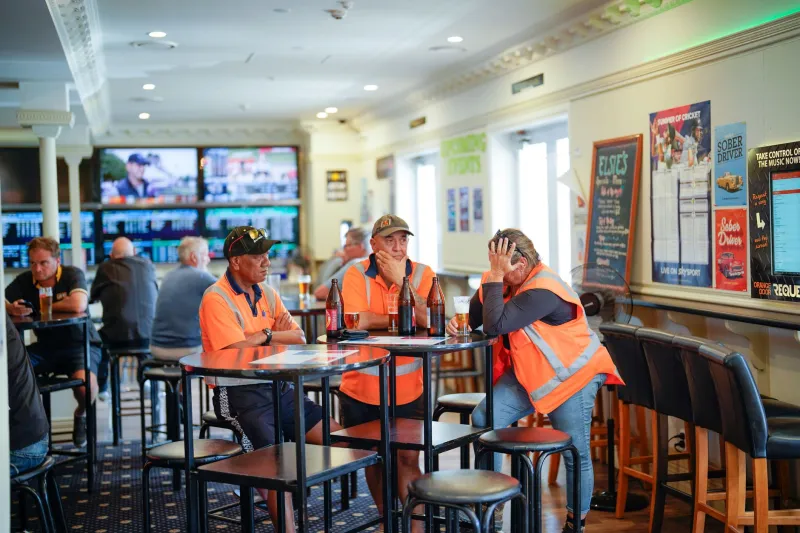
To understand why Australians relate to pokies the way they do, you have to go back to the pub. Not the sleek online lobby or the carpeted casino floor, but the sticky-floored local with a TAB in the corner and a row of pokies humming away near the toilets.
For decades, the pokie machine wasn't a destination — it was furniture. It was there when you grabbed a schooner after the footy, when you caught up with mates on a Friday arvo, when you ducked in out of the rain. The machine wasn't the point; the pub was. But the machine was always there, normalised into the background of ordinary Australian social life in a way that simply didn't happen in most other countries.
This matters because familiarity changes the psychological relationship people have with an activity. When something is woven into the rhythm of everyday life, it stops feeling like a high-stakes decision and starts feeling like wallpaper. The emotional charge that might accompany a first-time gambler in another country simply doesn't exist in the same way for someone who grew up watching their dad feed a few dollars into the machine while waiting for the footy to start.
The Awareness Paradox
Here's where it gets genuinely interesting from a psychological standpoint. Research consistently shows that Australians have relatively high awareness of gambling odds compared to international counterparts. Campaigns around responsible gambling have been loud and long-running. The maths of the house edge isn't exactly a secret.
And yet — Australia has one of the highest per-capita rates of gambling participation in the world.
Neuroscientists have a framework for understanding this kind of contradiction. The brain doesn't process risk and reward through a single, unified system. The prefrontal cortex — the rational, planning part of your brain — can absolutely know that the expected value of spinning a pokie is negative. But the limbic system, which governs emotion and motivation, doesn't speak the same language as a probability table. When you hear the chime of a near-win or feel the anticipation of reels slowing down, that's not your rational brain in charge. That's dopamine, doing what dopamine does.
The critical insight is that knowing something intellectually and feeling it emotionally are two entirely different cognitive events. Australians who say "I know I'll lose" are being completely truthful — and their limbic system is simultaneously, cheerfully ignoring them.
The Social Permission Structure
Culture acts as a permission slip. In societies where gambling is stigmatised or hidden, even people who want to participate face internal friction — guilt, shame, the sense that they're doing something they shouldn't. That friction is a genuine psychological brake.
In Australia, that brake is substantially weaker. When pokies are discussed openly at the dinner table, when mates compare their weekend sessions without lowering their voices, when sports coverage and gaming ads share the same airtime — the social cost of participation drops close to zero. And when the social cost drops, behaviour that might otherwise feel transgressive becomes... just a thing people do.
This isn't unique to gambling. Australians have a culturally embedded comfort with activities that carry acknowledged risk — surfing in shark-prone waters, camping in snake country, betting on horses that probably won't win. There's a cultural pride in not being precious about it. "She'll be right" isn't just a phrase; it's a risk tolerance framework.
The Online Shift and a New Paradox Layer
The migration of pokies from the pub to the phone screen has added a fresh wrinkle to this already complicated relationship. Online play strips away the social context that originally made pokies feel like background furniture. You're not in the pub with mates; you're alone on your couch at 11pm. The normalising scaffolding of the social environment is gone.
And yet the behaviour persists — arguably intensifies. Why? Because by the time online pokies became widely accessible, the psychological conditioning was already decades deep. The emotional familiarity built through years of pub-machine exposure transferred to the digital format almost seamlessly. The sounds, the visual rhythms, the anticipation loop — it all felt recognisable. Comfortable, even.
What's changed is the friction of access. Where the pub required you to leave the house, the phone requires nothing. That reduction in effort is, from a behavioural psychology perspective, enormously significant. Every point of friction in a behaviour chain reduces participation; remove it, and participation climbs.
Embracing the Contradiction
Perhaps the most distinctly Australian thing about all of this is the lack of existential crisis around the contradiction. In some cultures, knowingly participating in a losing activity would generate significant cognitive dissonance — a need to resolve the inconsistency through rationalisation or avoidance. Australians, broadly speaking, just... don't seem that bothered.
There's actually something almost philosophically sophisticated about it, once you stop trying to frame it as a problem. The Aussie pokie player who grins and says "I know I'll lose" is, in a sense, more honest about recreational spending than someone who convinces themselves their gym membership is definitely improving their health or that their wine habit is good for the heart.
The money spent on pokies, for many players, functions like any other entertainment budget — it's the cost of the experience, not an investment in an outcome. The spin is the product, not the jackpot.
That doesn't mean the relationship is uncomplicated, or that the risks disappear because they're acknowledged. But understanding why the paradox exists — culturally, neurologically, socially — is the first step to engaging with it clearly. And in Australia, clear-eyed engagement with a complicated situation has always been the preferred approach.